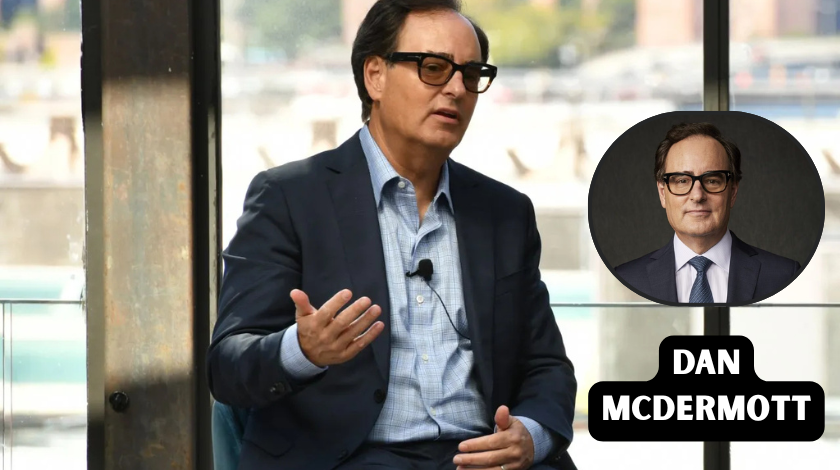
If you have ever found yourself completely absorbed by the post-apocalyptic world of The Walking Dead, intrigued by the gothic mysteries of the Anne Rice Immortal Universe, or captivated by the atmospheric storytelling of Dark Winds, you have experienced the creative vision that Dan McDermott brings to television. As the Chief Content Officer and President of AMC Studios, McDermott is one of the most influential figures in modern entertainment, quietly shaping what millions of people watch across cable networks and streaming platforms every day.
In November 2025, AMC Networks made a significant statement about its confidence in McDermott’s leadership by extending his contract through 2028. This move came at a critical time for the entertainment industry, as traditional cable networks face mounting pressure from cord-cutting trends. At the same time, streaming services continue to reshape how audiences consume content. The extension, which includes a base salary of $1.625 million annually plus substantial bonuses and equity awards, signals that AMC Networks believes McDermott possesses the strategic vision necessary to navigate these turbulent waters
But who exactly is Dan McDermott, and how did he rise to become such a pivotal figure in television? His journey represents a masterclass in career development in the entertainment industry, spanning three decades and touching some of television’s most iconic shows.
From UCLA Film School to Fox Broadcasting: Building the Foundation
Every successful career has its origins, and Dan McDermott’s story begins in the classrooms of the UCLA School of Theater, Film, and Television. This prestigious institution has produced countless Hollywood luminaries, and McDermott distinguished himself early by pursuing not just academic knowledge but practical craft. After completing his undergraduate degree, he continued his education as a screenwriting fellow at the American Film Institute, one of the most selective programs in the country for aspiring filmmakers.
This educational background gave McDermott something that many executives lack: a genuine understanding of the creative process from the writer’s perspective. He did not just study television from a business standpoint; he learned how stories are constructed, how characters develop, and how scripts evolve from initial concept to final production. This foundation would prove invaluable throughout his career.
McDermott entered the professional world during what many consider the golden age of network television, joining Fox Broadcasting Company at a time when the network was challenging established norms. At Fox, he held various roles, including developing and overseeing series that would become cultural touchstones. Imagine being in the room when decisions were made about The X-Files, The Simpsons, Married…with Children, Melrose Place, Party of Five, Beverly Hills, 90210, In Living Color, Martin, and Mad TV. McDermott was not just a witness to television history during this period; he was an active participant in shaping it.
His responsibilities extended beyond scripted programming. He also oversaw major live events, including the Emmy Awards and the Billboard Awards, giving him experience in the high-stakes world of live television production. This diverse portfolio at Fox provided McDermott with a comprehensive education in network operations, audience preferences, and the delicate balance between creative risk-taking and commercial viability.
The DreamWorks Revolution: First President of Television
In 1994, DreamWorks SKG was founded by Steven Spielberg, Jeffrey Katzenberg, and David Geffen, creating the first new major Hollywood studio in decades. When DreamWorks decided to expand into television production, they needed someone with proven creative judgment and executive experience to lead the charge. They chose Dan McDermott as their first president of television, a position he would hold for nearly a decade.
This appointment represented a significant milestone in McDermott’s career. At DreamWorks Television, he oversaw a programming slate that demonstrated his ability to identify and nurture groundbreaking content. Perhaps most notably, he shepherded Freaks and Geeks, the critically acclaimed series created by Paul Feig and produced by Judd Apatow. Though the show lasted only one season on NBC, it has since achieved legendary status as one of the most influential television series of its generation, launching the careers of actors like James Franco, Seth Rogen, Jason Segel, and Linda Cardellini.
McDermott also oversaw Spin City, the Michael J. Fox sitcom that ran for 6 seasons, demonstrating his ability to manage successful, long-running series. However, his most significant achievement at DreamWorks might have been his role in bringing Band of Brothers to the screen. This ten-part miniseries, executive produced by Steven Spielberg and Tom Hanks, set new standards for television production quality and established the template for the prestige miniseries format that dominates streaming platforms today. The series won numerous Emmy Awards and remains a benchmark for historical drama on television.
During his tenure at DreamWorks, McDermott developed a reputation as an executive who could bridge the gap between creative talent and business necessities. He understood that writers and directors needed support and protection to do their best work, but he also recognized the commercial realities that made such work possible. This balanced approach would become his trademark throughout his career.
The Producer Era: Di Bonaventura Pictures and Independent Creation
After leaving DreamWorks, McDermott entered a new phase of his career, becoming a producer, writer, and partner at Di Bonaventura Pictures Television. This move allowed him to work more directly on specific projects rather than overseeing entire programming slates. During this period, he developed credits on series including The Real O’Neals and Jupiter’s Legacy, demonstrating his continued relevance in an evolving television landscape.
Working as a producer gave McDermott a fresh perspective on the challenges facing content creators. He experienced firsthand the difficulties of getting projects greenlit, the complexities of production logistics, and the pressure to deliver content that would find an audience. This period also allowed him to maintain relationships with writers, directors, and actors across the industry, building the network of creative partnerships that would serve him well in future executive roles.
The Lionsgate-BBC Studios Partnership: Bridging Transatlantic Television
In May 2019, McDermott took on a new challenge as head of the Lionsgate-BBC Studios scripted TV partnership. This role required him to oversee all aspects of dealmaking, sales, development, production, and distribution for a collaboration between two major media entities. The position demanded a sophisticated understanding of international content markets, as Lionsgate’s American operations needed to align with BBC Studios’ British perspective and global reach.
This experience proved particularly valuable given the increasingly global nature of television consumption. Streaming services had begun to erase traditional geographic boundaries, and successful content needed to appeal to audiences across multiple territories. McDermott’s work at the Lionsgate-BBC partnership gave him direct experience with international co-productions, cross-border distribution strategies, and the cultural nuances that determine whether content travels successfully between markets.
However, this role would prove relatively brief, as a much larger opportunity emerged in 2020 that would bring McDermott back to the executive suite of a major media company.
Leading AMC Networks: Strategy for the Streaming Age
In April 2020, Dan McDermott joined AMC Networks as President of Entertainment and AMC Studios. The timing could not have been more significant. The COVID-19 pandemic had just begun to transform media consumption habits, accelerating trends toward streaming while simultaneously disrupting traditional production schedules. AMC Networks, like all cable programmers, faced existential questions about its future business model
McDermott’s mandate was clear: guide AMC Networks through this transition while maintaining the quality programming that had built the company’s reputation. As Chief Content Officer, he now oversees the development, production, acquisition, scheduling, and release of series and films across the company’s entire domestic distribution ecosystem. This includes targeted streaming services like AMC+, Acorn TV, ALLBLK, HIDIVE, Shudder, and Sundance Now, as well as cable networks AMC, BBC America, IFC, SundanceTV, and WeTV.
What distinguishes McDermott’s approach at AMC Networks is his recognition that different platforms serve different audience needs. Rather than simply porting cable content to streaming platforms, he has overseen strategies that treat each service as a distinct brand with its own identity. Shudder, for example, focuses specifically on horror content, while Acorn TV serves fans of British and international mysteries. This niche approach contrasts with the “everything for everyone” strategy of larger streaming services like Netflix or Disney+.
Under McDermott’s leadership, AMC Studios has continued to produce content for third parties and for AMC’s own platforms. The studio produced Silo for Apple TV+, demonstrating that AMC’s production capabilities can generate revenue and prestige even when content appears on competing services. This hybrid model—producing for owned platforms while also serving external clients—provides financial flexibility and creative opportunities that pure-play streaming services cannot match.
The Content Franchises: Walking Dead and Anne Rice Universes
Any discussion of Dan McDermott’s tenure at AMC Networks must address his stewardship of two major content universes that have defined the company’s recent identity: The Walking Dead franchise and the Anne Rice Immortal Universe.
The Walking Dead presented unique challenges when McDermott arrived at AMC. The flagship series, while still popular, was approaching its conclusion after eleven seasons. The challenge was not simply ending the main series gracefully but expanding the universe in ways that would maintain audience engagement without diluting the brand. Under McDermott’s oversight, AMC developed multiple spinoff series, including Fear the Walking Dead, The Walking Dead: World Beyond, Tales of the Walking Dead, and focused continuations following popular characters like Daryl Dixon and Rick Grimes.
This franchise management requires a delicate balance. Fans demand fresh content that honors what they loved about the original, but they also want innovation that justifies a new series. McDermott has navigated this by ensuring that spinoffs have distinct identities—Daryl Dixon takes place in France with different cultural contexts. At the same time, the upcoming Rick Grimes series promises to resolve long-standing storylines. The strategy recognizes that franchise fatigue is real but that genuine creative expansion can reinvigorate audience interest.
The Anne Rice Immortal Universe represents McDermott’s most ambitious creative undertaking at AMC. Acquiring the rights to Rice’s Vampire Chronicles and Lives of the Mayfair Witches novels, AMC committed to creating an interconnected universe of series based on these beloved books. The launch of Interview with the Vampire in 2022 received critical acclaim for its fresh take on the classic story, while Mayfair Witches introduced audiences to a different corner of Rice’s gothic world.
These adaptations required McDermott to make crucial decisions about how to update Rice’s work for contemporary audiences while respecting the source material. The casting of Jacob Anderson as Louis and Sam Reid as Lestat in Interview with the Vampire demonstrated a willingness to reimagine characters, bringing new dimensions to familiar stories. The critical success of these series validates McDermott’s approach to franchise development.
Additionally, McDermott has supported original series like Dark Winds, the noir thriller based on Tony Hillerman’s novels starring Zahn McClarnon. This series represents the kind of mid-budget, character-driven drama that has become AMC’s signature—prestigious enough to attract top talent and critical attention, but produced efficiently enough to work within cable television economics.
Leadership Philosophy: The Creative-Executive Balance
Having worked with some of the most demanding creative talents in Hollywood, from Steven Spielberg to Judd Apatow to Anne Rice’s estate, Dan McDermott has developed a leadership philosophy that prioritizes creative protection while maintaining business discipline. This approach reflects his background as a writer and producer; he speaks the language of creatives and understands their concerns in ways that many business executives do not.
In interviews and industry discussions, McDermott emphasizes the importance of partnership between networks and creators. He recognizes that television is fundamentally a collaborative medium, and that the best results emerge when executives provide support and resources rather than micromanaging creative decisions. This philosophy has enabled AMC to attract top-tier talent even when it cannot match the financial resources of larger competitors.
At the same time, McDermott has demonstrated a willingness to make difficult business decisions. The entertainment industry requires constant evaluation of what works and what does not, and McDermott has overseen the conclusion of series that no longer served their audience or financial goals. This balance—supporting creativity while maintaining commercial reality—defines effective television executive leadership.
Navigating Industry Transformation: Linear to Streaming
The contract extension through 2028 suggests that AMC Networks’ board believes Dan McDermott possesses the strategic vision necessary to guide the company through its most challenging transition yet: the shift from linear cable television to streaming-centric distribution. This transformation affects every aspect of the business, from content development to monetization.
McDermott has been candid about the challenges facing cable networks. Cord-cutting continues to reduce traditional subscriber bases, and advertising revenue on linear platforms faces pressure from digital alternatives. However, he has also articulated a vision for AMC’s future that does not simply abandon cable for streaming, but rather optimizes both distribution methods based on their strengths.
The company’s streaming portfolio now reaches 10.4 million total subscribers across its various niche services. While this number pales in comparison to Netflix or Disney+, it represents a highly engaged audience willing to pay for specialized content. McDermott’s strategy emphasizes depth over breadth—serving specific audience passions with targeted content rather than attempting to appeal to everyone.
This approach requires a sophisticated understanding of content valuation. A series that might not justify its cost on a broadcast network might be perfect for a niche streaming service with lower overhead and more targeted marketing. Conversely, flagship series like The Walking Dead still generate significant revenue through cable advertising and carriage fees, making hybrid distribution strategies optimal.
The Future of AMC Under McDermott’s Leadership
Looking ahead, Dan McDermott’s extended tenure provides AMC Networks with continuity amid industry uncertainty. His experience spanning traditional network television, premium cable, and streaming services positions him to make informed decisions about content investment and distribution strategy.
Several key challenges will define the coming years. First, AMC must continue building its streaming subscriber base while managing the decline of linear television. This requires content that attracts new subscribers while retaining existing ones—a balance that demands both fresh franchises and continued support for established series.
Second, the company must navigate an increasingly competitive content marketplace. With Netflix, Amazon, Apple, Disney, Warner Bros. Discovery, and Paramount all investing billions in original programming, AMC cannot compete on volume. McDermott’s strategy of niche specialization and targeted content creation offers an alternative path to relevance.
Third, technological changes, including artificial intelligence and new distribution platforms, will require adaptive strategies. McDermott’s background in both creative and business aspects of television suggests he can evaluate these technologies based on their actual utility rather than hype.
The entertainment industry will be watching closely to see whether McDermott can successfully transition AMC Networks into a sustainable streaming-era business. His track record suggests he possesses the combination of creative judgment, business acumen, and industry relationships necessary for this challenge. The contract extension through 2028 provides the time horizon needed for meaningful strategic execution.
Frequently Asked Questions About Dan McDermott
What is Dan McDermott’s current role at AMC Networks? Dan McDermott serves as Chief Content Officer and President of AMC Studios at AMC Networks. He oversees content creation, development, production, and distribution across all AMC Networks platforms, including cable channels and streaming services. His contract was extended through 2028 in November 2025
What major television shows has Dan McDermott worked on? Throughout his career, McDermott has been associated with iconic series including The X-Files, The Simpsons, Freaks and Geeks, Band of Brothers, Spin City, and The Walking Dead universe. At AMC Networks, he oversees Interview with the Vampire, Mayfair Witches, and Dark Winds.
Where did Dan McDermott work before joining AMC Networks? Before AMC Networks, McDermott was head of the Lionsgate-BBC Studios scripted TV partnership. He previously served as DreamWorks’ first president of television, worked as a producer at Di Bonaventura Pictures Television, and held various executive roles at Fox Broadcasting Company.
What is Dan McDermott’s educational background? McDermott received his B.A. in film and television from the UCLA School of Theater, Film and Television. He continued his education as a screenwriting fellow at the American Film Institute, giving him both academic credentials and practical writing experience
How has Dan McDermott impacted AMC Networks’ streaming strategy? Under McDermott’s leadership, AMC Networks has pursued a niche streaming strategy, offering specialized services such as Shudder (horror), Acorn TV (British content), and AMC+. Rather than competing directly with Netflix, this approach targets passionate audiences with specific content interests, reaching 10.4 million total streaming subscribers
Conclusion
Dan McDermott’s career trajectory offers a fascinating case study of the evolution of the television industry. From his early days at Fox Broadcasting through his tenure at DreamWorks, his producing career, and now his leadership at AMC Networks, he has consistently demonstrated an ability to adapt to changing industry conditions while maintaining a commitment to quality storytelling.
His current challenge—guiding AMC Networks through the transition from cable television to streaming—represents perhaps his most complex undertaking yet. The contract extension through 2028 suggests confidence in his ability to navigate this transformation successfully. For television viewers, McDermott’s continued leadership means more of the distinctive, character-driven content that has defined AMC’s best programming.
In an era of entertainment industry consolidation and homogenization, executives like Dan McDermott, who understand both the creative and business sides of television, remain essential. His career reminds us that behind every great television series stands not just talented writers, directors, and actors, but also executives who recognize quality and fight to bring it to audiences. As the industry continues evolving, McDermott’s combination of experience, relationships, and strategic vision positions him to remain a significant influence on what we watch for years to come.